Written and submitted by Emma Caraballo, Legislative Committee Member
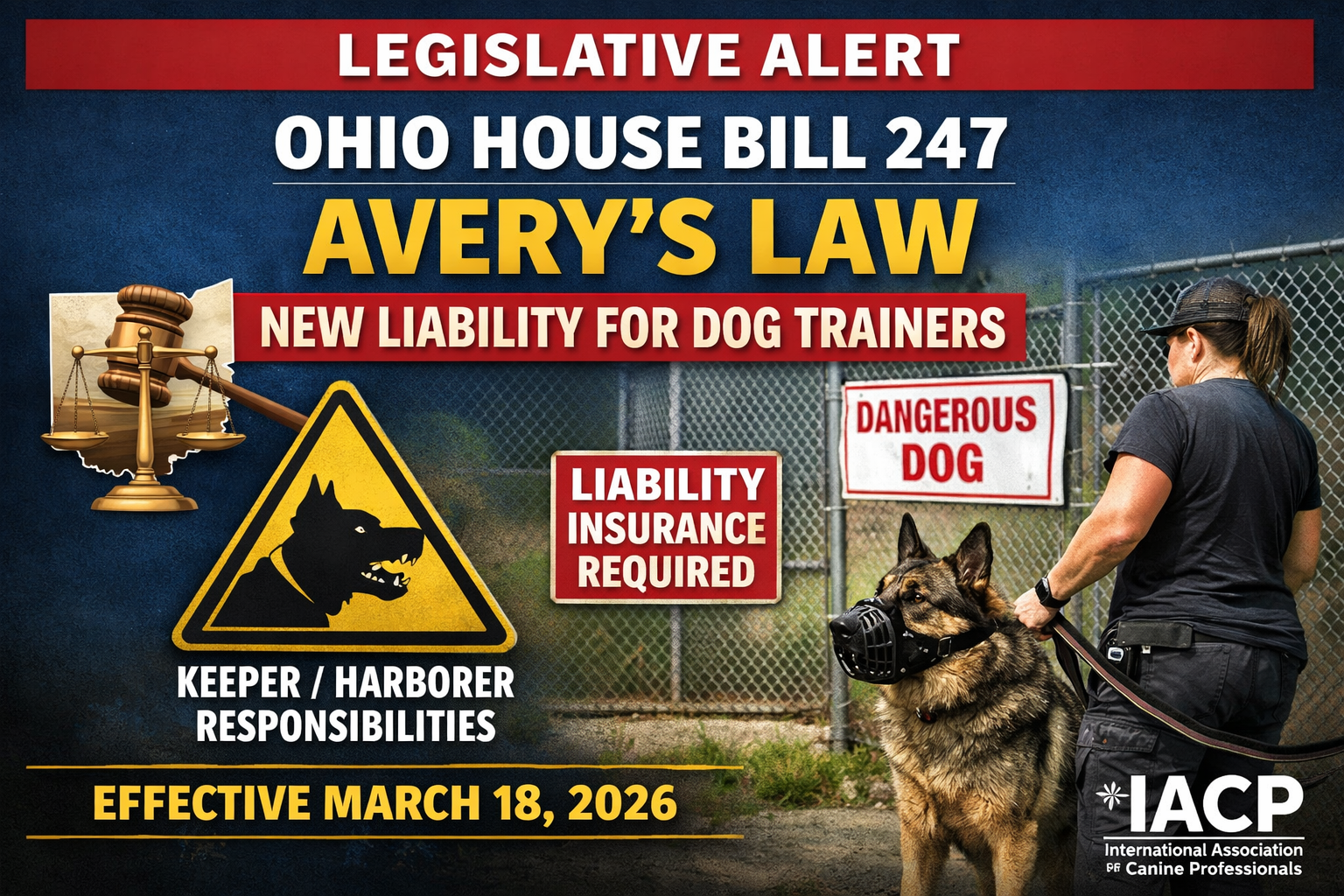
Ohio’s Avery’s Law is legislation slated to take effect on March 18, 2026. It reshapes how the state treats nuisance, dangerous, and vicious dogs, and it quietly, but powerfully, changes the risk profile for professional dog trainers. The law is aimed at public safety, but because it applies to not only owners but also harborers and keepers, it directly affects training businesses, boarding programs, and day-training setups.
A practical, trainer-focused look at what Avery’s Law means for your intake process, contracts, daily handling, and insurance:
Why Avery’s Law Matters to Trainers
Avery’s Law strengthens Ohio’s dog control statutes by defining and tightening standards for nuisance, dangerous, and vicious dogs, creating clearer criminal liability when a dog is not properly confined or controlled and causes harm, and requiring significant liability insurance for dogs formally labeled dangerous or vicious. For pet professionals, the key shift is that when a dog is in your care, you may be treated as a “keeper” or “harborer”. This means many of the law’s duties and penalties can apply to you, not just to the dog’s legal owner.
“Keeper/Harborer”: How Trainers Get Pulled In
Under Ohio law, an “owner” is not the only person responsible for a dog. Anyone who houses, feeds, supervises, or has substantial control over a dog can be considered a “keeper” or “harborer” during that time. In practice this includes board-and-train operators, day-training and day-care facilities, in-home trainers who take the dog out for walks or field trips, and sport or working-dog trainers who house client dogs on-site. When you are housing, handling or exercising a client’s dog, you can fall into that keeper/harborer designation for the purpose the dog is in your custody. That means the confinement and control standards in Avery’s Law apply to you while the dog is in your care. A failure to control the dog according to the law may expose you to criminal charges, not only the owner. If your business model includes boarding, board-and-train, or day-long handling, you should assume you are treated as a harborer or keeper for those dogs and act accordingly.
New Confinement and Control Standards
A core specification of Avery’s Law is that no owner, harborer, or keeper may “fail to keep the dog physically confined or restrained” on their premises. In practical terms, this means you must be able to show that dogs on your property are under reasonable physical control at all times. The law lists acceptable means of confinement and restraint including leash or tether, fence or secure yard, supervision, or other measures that keep the dog “under reasonable control.”
Taking a Designated Dog Into Training: What to Verify
If you accept a dog that has a bite history or formal nuisance/dangerous/vicious label, you should confirm the dog’s status, verify owner compliance, and acknowledge that while the dog is in your care you must handle it under strict standards even if the owner is relaxed at home. Explicitly ask “has this dog ever been declared a nuisance, dangerous, or vicious by any court or authority? Has it been cited for chasing, biting or injuring people or animals?” If there are any formal designations for the dog, the owner must comply with statutory requirements, such as registration and liability insurance. Request documentation where possible without just taking the owner’s word.
Liability Insurance: What Trainers Need to Confirm
Avery’s Law requires that owners, harborers, or keepers of dangerous, vicious, or nuisance designated dogs maintain at least $100,000 in liability insurance for each dog. For trainers, this has several implications: verifying that the owner is meeting their requirements and maintaining at least $100,000 of liability insurance for their dog and add a step to the intake process that requests proof of coverage. Trainers should also confirm with their insurance brokers that your general liability or professional liability policy covers work with dangerous or vicious dogs, there are no breed exclusions that conflict with the types of dogs you see, and the insurer understands that you take custody/harbor these dogs (not just handle them briefly). Your contract should clearly state that; the owner remains responsible for maintaining statutorily required insurance, the owner indemnifies your business if they misrepresent the dog’s history or status, and the owner remains primarily responsible for the dog’s legal designations and compliance, even while the dog is training with you.
Updating Intake Forms and Contracts
You should update your paperwork so you can prove on paper that you asked the right questions, received explicit disclosures or denials, and put the legal responsibilities where they belong.
Key updates to consider:
Add an Avery’s Law status section that includes clear yes or no questions such as:
- Has this dog ever been declared a “nuisance dog,” “dangerous dog,” or “vicious dog” by any court or authority?
- Has this dog ever been involved in any incident that resulted in a bite, injury, or official complaint?
Provide space for the owner to describe any incidents and list case numbers if relevant.
- Confirm registration and insurance for designated dogs. Add a check box or statement where the owner attests that:
- They have completed all required registrations or designations under Ohio law.
- They maintain at least 100,000 dollars in liability insurance for each dog that has been designated dangerous or vicious.
- They will provide documentation upon request and keep it current for the duration of training.
- Clarify ongoing owner responsibility. It’s recommended that you contract should state:
- The owner remains primarily responsible for compliance with Avery’s Law, including registration, tagging, and maintaining insurance.
- The owner must notify you immediately if the dog’s legal status changes (e.g., a new dangerous designation after an incident).
- Misrepresentation or nondisclosure of bite history or legal status is grounds for immediate termination of services, with no refund.
- Document owner disclosures. Keep copies of forms, emails, and notes where owners describe the dog’s behavior and history. Date them and store them with the client file. This helps if there is ever a dispute about what you were told.
A well-designed intake and contract language not only clarify expectations, but also create a paper trail showing you took the law seriously.
Tightening Physical Control and Facility Design
Because “failure to keep the dog physically confined or restrained” is now a criminal offense with escalating penalties, your facility’s physical setup and daily routines matter more than ever. Steps to consider:
- Secure enclosures
- Use kennels, runs, and crates that are structurally sound, escape‑resistant, and properly latched.
- For any dog with a bite or chase history, consider higher‑security enclosures, covered runs, and padlocked gates.
- Double‑gate systems
- Install double‑door or double‑gate entries where dogs move between kennel and yard or building and parking lot.
- Ensure that only one gate is open at a time and that staff are trained to check both gates before passing through.
- Clear leash policies
- Require that all client dogs arrive and leave on leash, even if “they’re friendly.”
- Establish written rules prohibiting off‑leash movement outside secure areas, except in clearly defined training scenarios in fully enclosed spaces.
- For high‑risk dogs, consider using a leash plus backup safety (e.g., double‑clipped harness, drag line in fenced yards).
- Handling protocols
- Use appropriate tools for safety (muzzles, head halters, long lines, safety doors) when indicated.
- Train staff in reading body language, safe transfer between handlers, and what to do if a dog slips a collar or bolts.
- Incident logs
- Record any incidents, near‑misses, escapes, or aggressive displays, even if no one is hurt.
- Note the date, time, staff present, and what was done to prevent recurrence.
- If needed, adjust handling protocols or housing based on patterns you see.
These practices are good risk management in any state, but under Avery’s Law they also help show that you took “reasonable control” seriously.
Screening Dogs
Avery’s Law doesn’t force you to work with every dog. In fact, it’s now more important to screen carefully and decline cases that exceed your facility’s safety capacity. If you aren’t sure if your facility can meet the requirements of the law the safest option would be to decline taking the dog and refer them to a trainer you know can meet the legal requirements.
Avery’s Law is ultimately about preventing tragedies, but it also creates new duties for anyone who temporarily harbors or keeps a dog. As a professional dog trainer in Ohio, treating those duties as part of your everyday operations, rather than background legal noise, will help you protect your staff, your business, dogs and clients.