LEGISLATIVE ALERT UPDATE
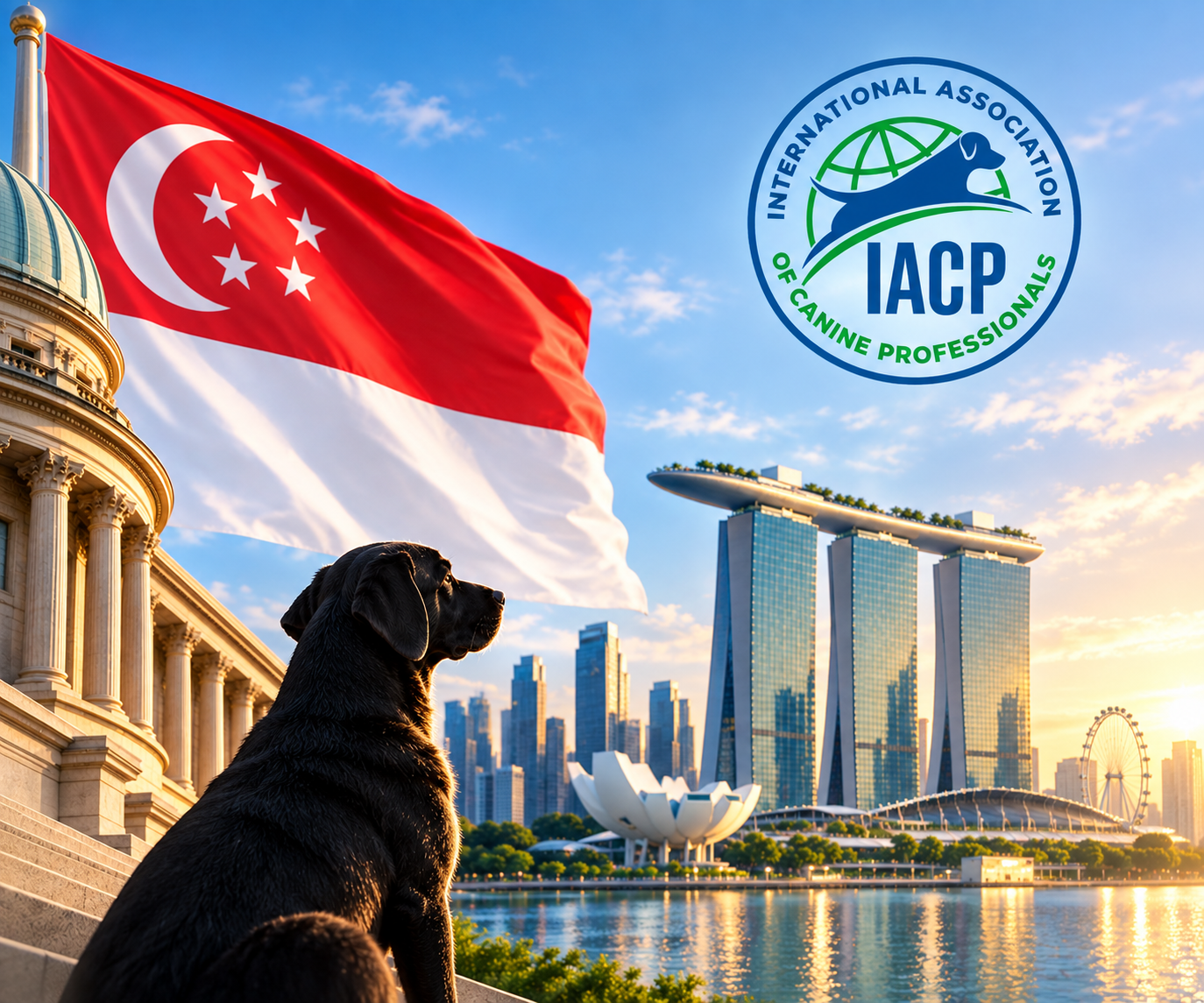
The IACP Legislative Committee has been closely monitoring developments in Singapore regarding proposed standards for professional dog trainers. On October 3, 2026, Singapore’s Animal & Veterinary Service (AVS), a cluster of the National Parks Board, announced its new Code of Animal Welfare for Dog Trainers.
While the new Code does not ban e-collars, prong collars, or the use of positive punishment or negative reinforcement, it establishes significant restrictions governing when trainers may utilize methods AVS considers more aversive.
What the New Code Requires
Under the new Code, dog trainers must adopt a Least Intrusive, Minimally Aversive (LIMA) approach and use positive reinforcement as the foundation of behavior-modification plans. The Code states that trainers must work through each step of the Hierarchy of Behavior Change Procedures without success before considering more aversive strategies. This requirement could significantly restrict a trainer’s ability to exercise professional judgment when determining the most appropriate training plan for an individual dog, particularly in cases involving serious behavioral or public-safety concerns. For instance, although electronic collars and prong collars are not expressly prohibited under the new Code, their use now exists within a regulatory framework that strongly favors less aversive alternatives and requires justification before escalating to more aversive procedures.
Before moving to a more aversive intervention, trainers are also expected to conduct a risk-benefit analysis and determine that the anticipated benefit outweighs the potential harm.
The Code also imposes substantial documentation requirements. Trainers must maintain records for at least two years, including behavioral history, triggers, incidents, training methods, outcomes, and communications with clients. These records may be requested for inspection by NParks.
Notably, AVS states that failure to meet the Code’s minimum standards may be used as evidence in support of prosecution under Singapore’s Animals and Birds Act. This makes the distinction between a recommended best practice and a mandatory minimum standard particularly important for trainers.
The Code Recognizes All Four Quadrants
There are also noteworthy provisions within the Code that recognize the broader science of learning and behavior.
AVS specifically requires trainers to demonstrate knowledge and proficiency in all four quadrants of operant conditioning. The Code further states that trainers should understand the full spectrum of dog-training approaches to avoid biases in the selection of methods. This is significant. The Code does not establish a purely positive-reinforcement training model. Instead, it establishes a hierarchy governing when and under what circumstances more aversive interventions may be considered.
Where IACP Certification Currently Stands
The IACP has been in communication directly with AVS regarding its recognition of professional dog-training certifications. At AVS’s request, the IACP provided detailed information regarding our certification standards and requirements.
Despite those communications, IACP certification is not currently included among the outside certifications recognized under AVS’s Accredited Certified Dog Trainer framework.
The IACP remains concerned that qualified professional trainers and legitimate certifying organizations should be evaluated according to objective standards of education, competency, ethics, continuing education, and practical experience, rather than excluded based upon differences in training philosophy.
Why This Matters Beyond Singapore
While these requirements currently apply to trainers operating in Singapore, developments such as this warrant attention throughout the professional dog-training community.
The concern is not simply whether a particular training tool is banned. Regulatory frameworks can significantly affect professional practice by determining when a tool may be used, what methods must first be attempted, how its use must be justified, and what documentation a trainer must maintain.
The IACP supports high standards of animal welfare, professional competency, informed decision-making, and the humane and ethical application of training methods and equipment. We also believe qualified professionals must retain the ability to make individualized training decisions based upon the dog, the behavior being addressed, the circumstances involved, and the needs and safety of both the dog and the public.
The IACP Legislative Committee will continue monitoring the implementation of Singapore’s new Code and our ongoing concerns regarding certification recognition.
The IACP would also like to extend our sincere appreciation to Jeffery Ong and Christine Ho for their time, dedication, and valuable contributions as members of the workgroup organized by the Singapore government. Their participation provided an important opportunity to represent the perspectives of professional dog trainers and advocate for a balanced, practical approach to training standards and animal welfare. We are grateful for their efforts and commitment to ensuring that the voices of experienced professionals are heard throughout this process.