The International Association of Canine Professionals urges members, Oregon residents, and allied animal professionals to oppose Oregon Initiative Petition 28, also known as the PEACE Act.
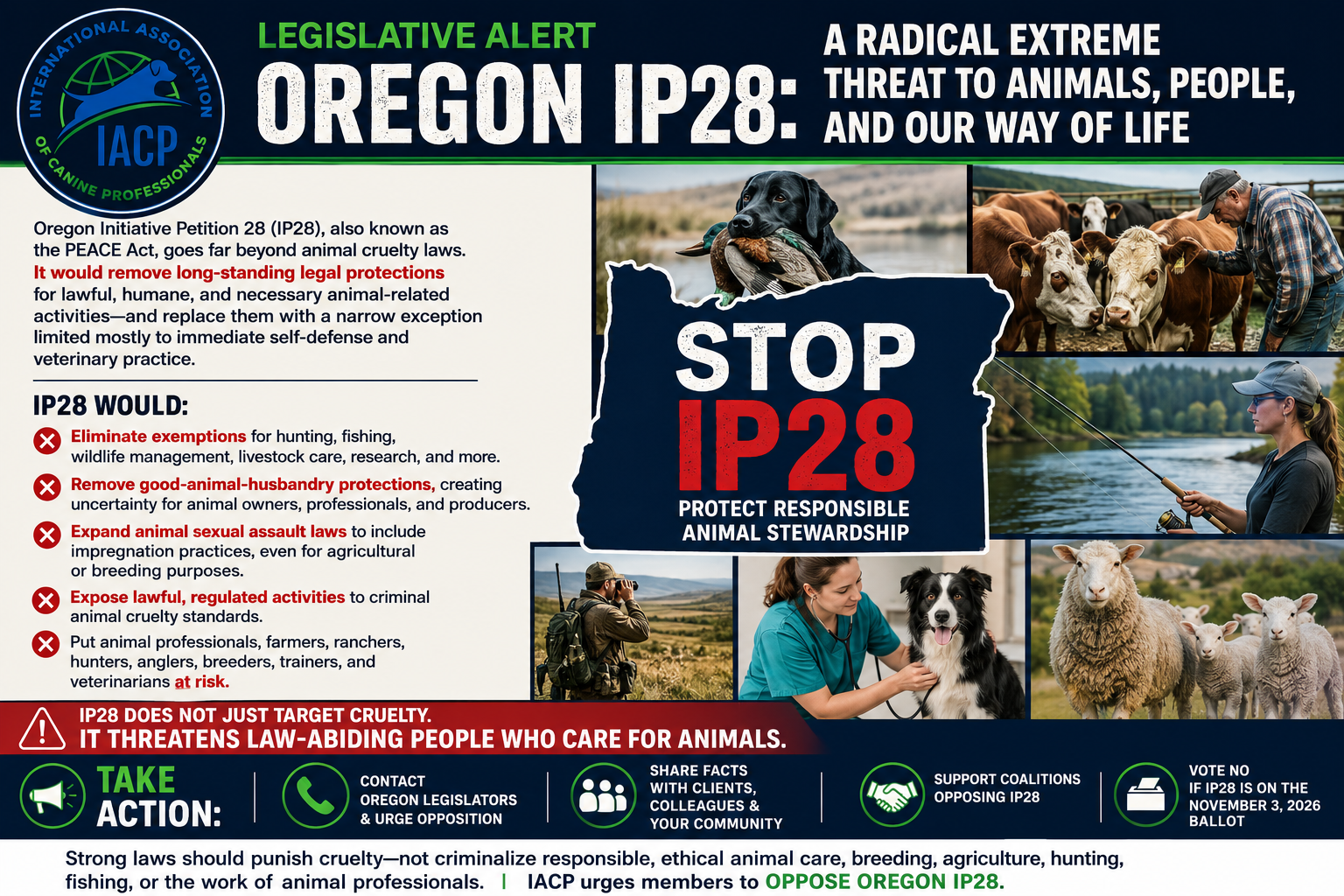
Although IP28 is being promoted as an animal cruelty measure, Oregon already has laws addressing animal abuse, neglect, abandonment, animal fighting, and other criminal conduct. IP28 goes far beyond strengthening cruelty laws. It would remove long-standing legal exemptions that protect lawful, humane, and necessary animal-related activities.
If passed, IP28 would dramatically expand Oregon’s animal cruelty statutes by removing protections for accepted animal husbandry, livestock care, breeding practices, hunting, fishing, wildlife management, animal agriculture, research, and other currently lawful activities. The measure would replace existing “authorized by law” protections with a much narrower exception limited largely to immediate self-defense and veterinary practice.
For IACP members, this matters because broad, poorly tailored animal legislation rarely stops with one industry. Measures like IP28 shift animal policy away from practical welfare standards and toward ideology-driven restrictions that can place responsible owners, trainers, breeders, handlers, farmers, ranchers, veterinarians, sportsmen, and working-animal professionals at risk.
Why IACP members should oppose IP28
IP28 would undermine responsible animal ownership and professional animal care by criminalizing or chilling normal, lawful animal practices rather than targeting actual cruelty.
The measure removes good-animal-husbandry protections from Oregon law. These protections currently recognize that some animal care practices may be necessary, humane, and accepted when performed properly. Eliminating that protection creates uncertainty for anyone who works with animals in a professional, agricultural, sporting, breeding, or management capacity.
IP28 also expands animal sexual assault provisions to include impregnation practices, even when done for agricultural or breeding purposes. This could affect livestock producers and may raise serious concerns for lawful breeding programs and reproductive management.
The initiative would also threaten Oregon’s hunting, fishing, and wildlife-management communities by exposing the lawful taking of animals to criminal animal-cruelty standards. These activities are not cruelty when conducted under existing conservation, licensing, and wildlife-management laws.
For dog professionals, IP28 should be viewed as part of a broader trend: emotionally appealing legislation that sounds protective but is written so broadly that it can punish responsible animal stewardship. IACP supports strong enforcement against true abuse and neglect. We do not support legislation that erases the distinction between cruelty and lawful, humane animal care, training, breeding, husbandry, food production, wildlife management, or sport.
Take action
Oregon members should oppose IP28 and educate clients, colleagues, lawmakers, and community members about its overreach.
Members can help by:
- Contacting Oregon elected officials and urging opposition to IP28.
- Sharing accurate information with clients and fellow animal professionals.
- Supporting coalitions opposing IP28.
- Encouraging Oregon voters not to sign or support the petition.
- Monitoring whether IP28 qualifies for the November 2026 ballot.
Animal cruelty laws should punish cruelty. They should not criminalize responsible animal care, ethical breeding, lawful hunting and fishing, humane livestock production, wildlife management, or the work of animal professionals.
Oregon’s IP28 is not yet moving through the legislature as a bill. It is a citizen initiative petition, meaning it bypasses the normal legislative process and goes directly to voters if enough valid signatures are collected and verified.
As of late May 2026:
IP28 has reportedly exceeded the minimum signature threshold required to qualify for Oregon’s November 2026 ballot. However, signatures have not yet been fully verified by election officials. If certified, Oregon voters will decide the fate of this measure on November 3, 2026. IACP members are encouraged to educate clients, colleagues, policymakers, and the public now about the broad and unintended consequences of IP28 before the measure reaches voters.
For IACP purposes, this means the window for advocacy is right now, before the election. Once a measure reaches the ballot, public education efforts become critical because voters—not legislators—will make the final decision.