
Behavior Modification Overrides Obedience
By Jessica Feliciano
I remember when the instructor of the drop-in style drill class yelled out, “Why did you reward that?” to me when my dog broke her down stay, stood up, and started walking towards me after another dog in the class was barking and that dog’s owner began yelling. My female Rottweiler left her down stay, calmly walked over to me, and sat by my side. I marked and rewarded her immediately. In fact, we had a party! Even though she broke the down stay, she made the best social decision in that situation and I wanted to make sure she knew it. Yet I also understood why the instructor was confused at my response. This can sometimes create friction between professionals who focus on obedience and professionals who focus on behavior work – not to mention it can really confuse clients.
I adopted my Rottweiler because she was going to be euthanized for aggression – the shelter staff was unable to examine her or touch her without sedation. Once I brought her home she displayed aggression towards unknown people as well as other dogs both on and off the leash. We worked through A LOT of behavior modification and eventually began training in group classes for further exposure. Sure, I wanted to continue to improve on her obedience. But our main priority was her aggression and the behavioral work needed to modify it.
When working with aggression cases, there’s obviously a safety risk to others. In cases of fear and anxiety there may be a safety risk to the dog themselves. This can be very different from your average obedience training program and for me, it takes precedence any day. Of course obedience training can help support behavior modification in many ways, but I think it’s really important to be able to separate the two when needed. When are we asking the dog to do something just because we want compliance versus when is the dog making a choice where they are more in alignment with being emotionally sound?
Since I primarily see aggression, fear, and anxiety cases I see it often when I work with clients. Dog owners are majorly concerned with their dog’s behavior problems involving aggression, fear, and/or anxiety. However, they will also fixate or focus on obedience commands. And that’s not wrong! But we need to be mindful of when the two overlap. And when they do overlap, if the dog makes a socially appropriate choice – EVEN THOUGH at the same time they are ignoring or breaking an obedience command – the socially appropriate choice needs to be reinforced. Because the improvement of the behavior problems is more important than the obedience itself.
When my dog was in a down stay in that group class while the other dog started barking and the owner started yelling, that was a situation in which she previously would have reacted by barking, lunging, and snarling. She would have engaged in conflict. And yet, when she was presented with that situation in class she voluntarily (without instruction from me) chose to disengage from the chaos and avoid conflict with the other dog and owner. She didn’t feel secure enough to hold the down stay and she was still learning to proof her stay in general, but she made the choice to ignore what was going on and seek the support of being closer to me. And for our goals of working through her aggression, that was an excellent choice on her part in

my opinion. I would rather her make a socially acceptable choice over keeping herself in a position for the sake of obedience that might push her discomfort to the point of displaying aggression. And that’s why I believe behavior modification should override obedience in these situations. I explained all of this to the instructor of the class afterwards and thankfully she was able to see my point.
Other similar examples can include:
While working with a dog who normally barks and lunges at other dogs on leash, an owner may also be working on loose leash walking at the same time. On one occasion they may pass another dog and their dog may disengage and look away from the other dog, but may go to sniff the ground in the other direction and pull on the leash a little. In this context, I care less about the leash pulling and care more about the dog choosing to ignore the other dog.
While working with a dog who may display aggression towards people in the tight confines of an apartment building, an owner may also be working on “wait” at a doorway to the stairwell. There might be a time that the dog is told to wait, and a stranger surprises them from around a corner and brushes up right past them. If the dog breaks the wait and moves forward but looks at the person and looks away, without displaying aggression, I think that’s more valuable to reward than the wait itself.

While working with a dog who is fearful of noises, an owner may also be doing obedience to help boost confidence and engagement. They may come across a moment where they are working on eye contact and a loud noise presents itself. If in the past the dog would hear loud noises and bolt to run away from it, but they stand still this time and just break eye contact with the owner, I believe that moment of bravery should still be encouraged instead of worrying about the loss of eye contact.
While working with a dog who displays resource guarding over items, an owner may also be working on “leave it,” too. Let’s say there’s a time when a valuable item drops on the floor and the owner tells the dog to “leave it” but the dog grabs it anyway. If the dog gives the item up afterwards with a “drop it” or a trade for something else, I would still reward that because I always want that dog to know it’s in their favor to give items up. Even if they didn’t listen about ignoring the item initially.
The number of situations that may arise where a dog’s progress in their behavioral issues is challenged and in conflict with an obedience cue are vast and infinite. But the concept is simple and for the dog it can be profound. That’s why it’s beneficial to have these conversations with owners and other professionals who may be working with the same dog in other capacities.
All of this is not to say you can’t eventually work your way to having BOTH the dog’s behavior modification as well as obedience on point together. I’m just here to bring awareness to when we should be cognizant of the overlap and keep our goals for socially appropriate behavior in the forefront of our priorities for the sake of the dogs as well as for the sake of the public.
Author Bio:
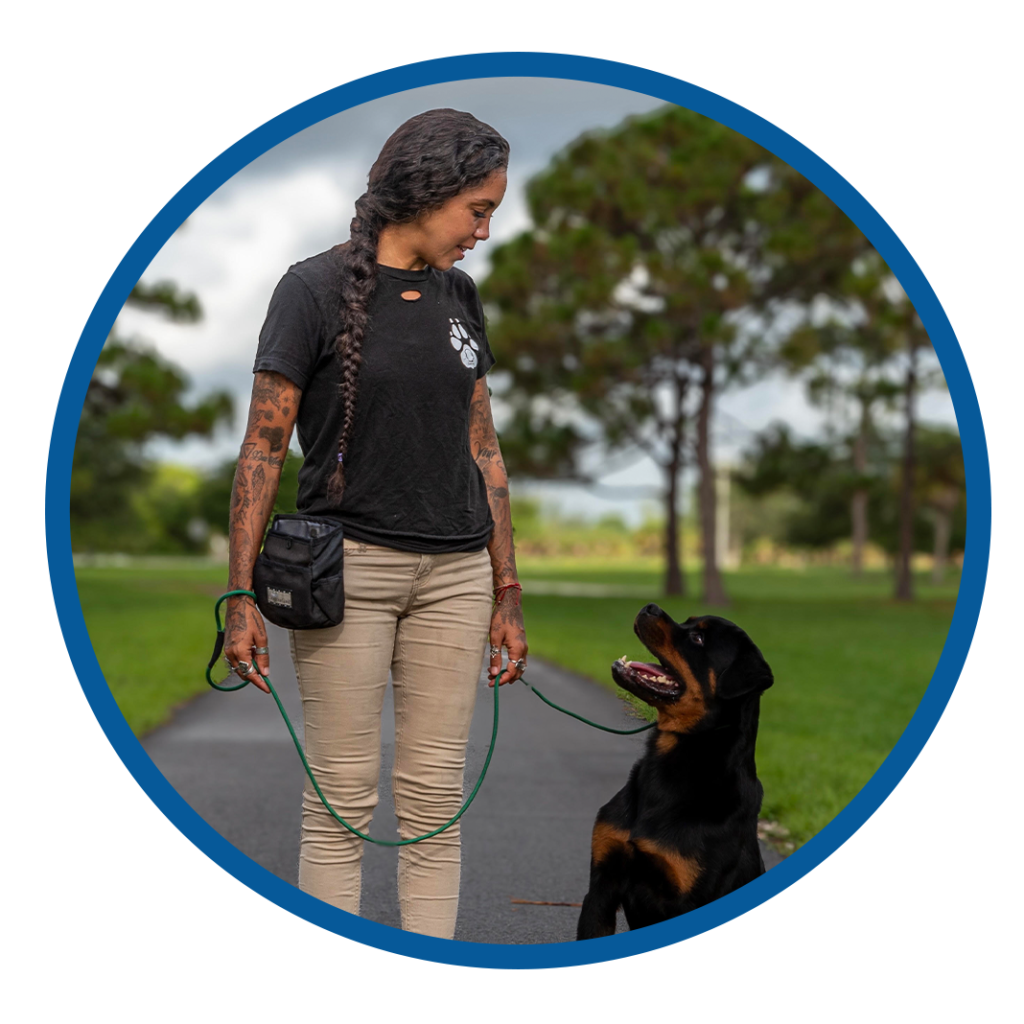
Jessica Feliciano owns RotNDog Training & Behavior Consulting in Florida and has been working with dog behavior since 2004. She enjoys challenging cases and empowering owners to feel confident and comfortable in managing their dog’s behavioral issues.
Also in this issue: